



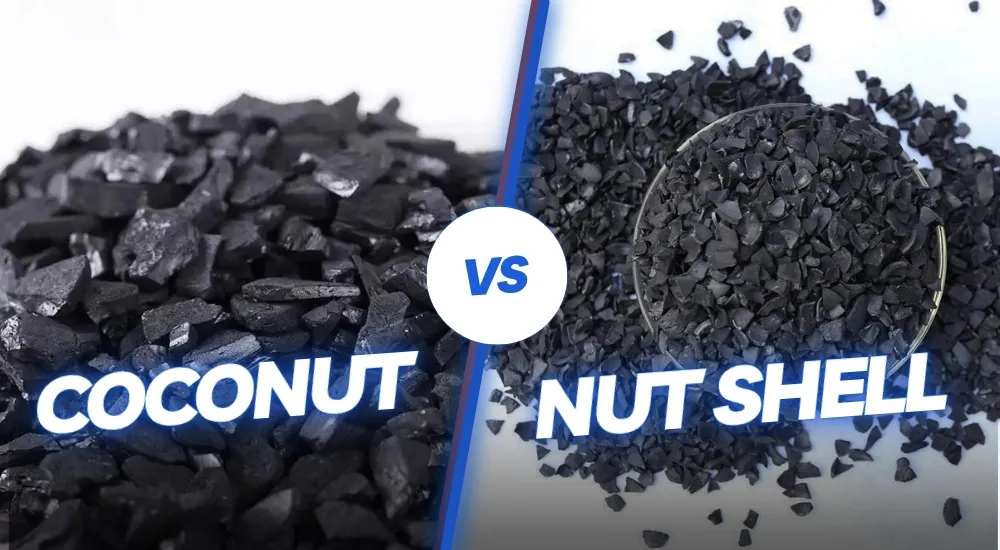
Picture a 25 kg bag of granular activated carbon. Black, irregular, dry, odourless, a little dusty at the seams. Now picture an identical bag filled with nut shell carbon instead. From the outside, you cannot tell them apart especially for smaller size — and that similarity is exactly where money changes hands.
Coconut shell and nut shell carbon are both made from agricultural by-products, both are usually activated with steam, and both are sold in the same mesh sizes and the same packaging. The difference is invisible in the bag and very visible in your process. One is engineered to strip small molecules out of water and gas and to survive years of backwashing cycles. The other is engineered to lift colour and bulky organics out of liquid streams at a lower cost per tonne.
Because coconut shell carbon carries a real price premium, the incentive to substitute is always present. This article is not a ranking of the two materials — “which is better” has no answer. It is a practical guide to confirming which one you actually received, using checks you can run at your desk, at sample stage, and eventually in your own plant.
A note on terminology, in the trade you will meet “nut shell activated carbon”, “fruit shell activated carbon”, “apricot shell carbon”, “peach shell carbon”, “walnut shell carbon” and “palm kernel shell carbon”. The last five all describe the same family — crushed stone-fruit and hard nut shells. “Nut shell” is the term English-speaking specifiers and buyers use, so it is the term used throughout this article. “Fruit shell” is a direct translation from Chinese supplier catalogues and appears in a lot of exported content; treat it as a synonym, not as a separate product category.
Five difference you can tell
1. Look at the shape
Coconut shell and nut shell carbons are both crushed products. The granules are irregular, with natural fracture edges, and the size range is never perfectly uniform. Flakes and crescent-shaped fragments are common in coconut shell grades because the shell itself has that geometry. But for 30*80mesh small size, it can not tell by visual inspection. Only larger size, some experienced can tell them instantly.

2. Weigh one litre
Because the strength of coconut shell carbon is higher, so the bulk density is larger than other types of activated carbon. So you can weight the carbon that you have received. This is the check worth doing first, because it needs nothing but a measuring jug and a kitchen scale.
Fill a 1-litre container with dry granules, tap it level without compacting, and weigh the contents.
- Coconut shell carbon generally lands between 430 and 530 g/L.
- Nut shell carbon generally lands between 350 and 480 g/L.
- Wood-based carbon sits lower still, and formed coal-based carbon usually sits higher.
Nut shell carbon is typically the lightest of the common grades and coconut shell is noticeably denser, so a litre of coconut shell carbon will usually outweigh a litre of nut shell carbon by a comfortable margin — often 40 to 80 grams.
One caution. Moisture inflates weight. Dry the sample first if you can, or at least test a sample from the middle of the bag rather than from the open top, which has been breathing factory air.
3. Watch what happens in water
Drop a spoonful of granules into a glass of water and watch.
Nut shell carbon, being lighter, tends to stay at or near the surface for longer. Coconut shell carbon wets and settles more readily. If you watch a saturated bed, you will also see air displaced from the pores as a stream of very fine bubbles — dense carbon with a micropore network tends to release a mass of tiny, closely packed bubbles, while a carbon with larger openings releases coarser, less regular bubbles.

4. Rub a handful, feel the hardness
Take a handful of granules and rub them firmly between your palms, then look at your hands.
Quality coconut shell carbon has high ball-pan hardness, which shows up as very little dust and granules that hold their shape under pressure. A handful of it leaves only a faint smudge. Carbon with low hardness sheds visible black powder, and individual granules crumble when you press them between finger and thumb.
Fines do not stay in the bed — they travel. They blind downstream cartridge filters, they raise pressure drop, they foul RO membranes, and in gold recovery they carry adsorbed gold out of the circuit with the tailings. Hardness is the parameter that decides whether your carbon lasts three years or one.
5. Check the appearance color
Fresh, well-made coconut shell carbon usually reads as dark brown to brownish-black with a matte surface; you can often sense the plant origin under the blackness. Carbon that is suspiciously jet-black with an oily sheen deserves a second look — that appearance is more typical of coal-based grades or of material that has been treated to look premium.
But colour varies with carbonisation temperature and cooling, and no serious purchaser should reject a batch on colour alone. File it alongside the other observations.
Get Factory Price & Free Samples
Professional activated carbon manufacturer with 21+ years of experience. Customized solutions for water treatment, air purification, food refining, gold recovery and more.
The Third Party Test
For anything above a trial quantity, do not rely on the supplier’s own certificate. Send a 1–2 kg pre-shipment sample to an accredited third-party laboratory — SGS, Intertek, or a local ASTM-accredited lab — and have it tested against the same methods listed on your purchase order.
Third-party iodine and hardness testing typically costs a few hundred dollars. Against a container load worth tens of thousands, that is not an expense; it is the cheapest risk transfer available to you. For orders above roughly ten tonnes, add a pre-shipment factory inspection while you are at it.
Which one does your application actually need?
Once you can tell them apart, the buying decision becomes straightforward — and it is a matching exercise, not a quality ranking.
Choose coconut shell carbon when the target is small molecules, or when the bed has to last. Drinking water and municipal dechlorination, removal of trihalomethane precursors, VOC and solvent recovery, gas-phase adsorption and odour control, gold recovery, catalyst support, and any duty that involves frequent thermal regeneration or aggressive backwashing. Micropore dominance, high hardness and low ash are precisely what these jobs require, and there is no cheaper substitute that performs as well over a full service life.
Choose nut shell carbon when the target is colour and bulk. Decolourisation of sugar syrup, glucose, monosodium glutamate, fruit juice and beverage streams; purification in food and pharmaceutical processing; decolourisation of dyeing, printing and pigment wastewater; and streams where pollutant molecules span a wide range of sizes. Here the mesopore fraction does the work, and a good apricot or peach shell carbon can deliver close to coconut shell decolourisation performance at a materially lower cost.
And when you compare prices, compare the right number. Price per tonne is almost meaningless on its own. For example, you buy coconut shell activated carbon with lower price, but poor quality will lead to gold loss, so in fact, it will casue the total cost increase in the real gold mine.
Frequently asked questions
Is nut shell activated carbon just a cheaper, inferior version of coconut shell carbon?
No. It is a different material with a different pore architecture, and it is the better choice for several jobs — particularly decolourisation and the removal of large organic molecules.
Does a higher iodine number always mean better performance?
No. Iodine number measures adsorption of a small molecule and therefore tracks micropore volume. If your target contaminant is a large colour body, a carbon with a lower iodine number but a richer mesopore structure may outperform a higher-iodine carbon in your process. Choose the carbon whose pore distribution matches your molecules, then verify with a test on your actual stream.
Why is coconut shell carbon more expensive?
Two reasons: a scarcer feedstock concentrated in tropical growing regions, and a lower activation yield, so more raw material is consumed per tonne of finished carbon. The result is a tighter, harder, lower-ash product that commands a premium — which is precisely why substitution happens, and why it pays to check.
The bottom line
Coconut shell and nut shell activated carbon are not competing grades of the same product. They are two different tools that happen to arrive in identical bags. Coconut shell carbon is a hard, low-ash, narrow-aperture carbon built for small molecules and long service life. Nut shell carbon is a lighter, broader-aperture carbon built for colour removal and larger organics at a lower cost.
Planning a purchase? Send us your target parameters — iodine number, mesh size, application and required certifications — and we will recommend the grade that matches your process, with a full batch certificate of analysis and a third-party test result on the pre-shipment sample.