



Coconut Shell Granular Activated Carbon
Granular activated carbon made from selected coconut shells through steam activation. Dominated by micropores and rated up to 99% hardness, it delivers the highest adsorption capacity per gram among common carbon types — the first choice for gold recovery, drinking water polishing, and high-purity liquid purification.

What is Coconut Shell Granular Carbon
Coconut shell granular activated carbon is produced by carbonizing dried coconut shells and activating them with high-temperature steam. Because the raw shell is naturally dense in lignin and carbon, the finished granule develops an overwhelmingly microporous structure — pores below 2 nm that give it one of the highest working capacities for small-molecule contaminants of any commercial carbon, with surface areas commonly exceeding 1000 m²/g.
Three properties set it apart in demanding service. First, hardness: dense shell-derived granules resist attrition far better than coal or wood carbon, which matters enormously in gold CIP/CIL tanks and backwashed water filters where every gram lost is money out of the plant. Second, purity: naturally low ash and low metal content, further reduced by acid or water washing for food, pharma and potable applications.
Technical Specifications
Every batch ships with a Certificate of Analysis; SGS / BV third-party inspection available before loading.
Coconut GAC Size
Smaller granules adsorb faster but create more pressure drop; larger granules survive aggressive hydraulics and tank agitation. Match the cut to your equipment, not just your contaminant.
Coarse, ultra-hard granules for gold CIP/CIL/CIC circuits and deep gas beds — minimal fines generation under constant agitation.
The benchmark grade for municipal and industrial water columns — balanced kinetics, backwash stability and pressure drop.
Finer cut for drinking water polishing, dechlorination and POE/POU cartridges where contact time is short.
Fine granules for high-efficiency liquid polishing, sweetener decolorization and specialty purification.
Water-washed for rapid wetting and low dust; acid-washed to cut ash below 3% and neutralize pH for food-grade duty.
Any mesh cut, iodine value or CTC level can be produced to order, with OEM packaging available.
Premium Activated Carbon Manufacturer Since 2005
Quality-first activated carbon manufacturer, strict QC guarantees stable specs, fast lead time for global buyers.
21+ Years Experience
Activated carbon manufacturing since 2005.
20,000 Tons Annual Capacity
Large-scale production, stable lead times.
Serving 80+ Countries
Europe, Americas, Asia, Africa.
ISO 9001 Certified
Full quality management system.
On-site QC Laboratory
Every batch tested before shipment.
OEM / ODM Available
Custom mesh size, packaging, branding.


Key Applications
Gold Recovery ⭐
The industry standard for CIP / CIL / CIC leaching — 97–99% hardness keeps carbon losses and fine-gold carryover to a minimum through repeated strip-regeneration cycles.
Drinking Water
Removes chlorine, taste, odor, THM precursors and trace organics in municipal plants, bottling lines and residential cartridges.
Wastewater Polishing
Tertiary COD, color and toxic-organic removal for discharge compliance and water reuse in chemical, pharma and mining effluents.
Food & Beverage
Decolorization and impurity removal for sugar syrups, edible oil, MSG and fermentation products using acid-washed grades.
Air & Gas Purification
Low-concentration VOC abatement, odor control and biogas polishing in fixed beds; excellent for small-molecule gas capture.
Catalyst Carrier
High-purity, chemically stable support for precious-metal catalysts in refining and fine chemical synthesis.
Packaging & Loading
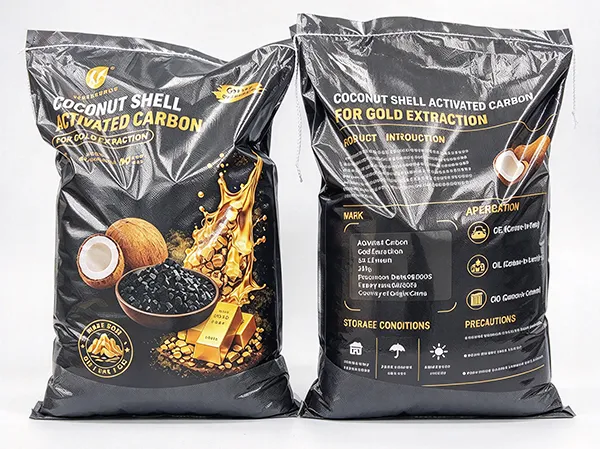
- 25 kg PP woven bags — palletized, standard export
- 500 kg jumbo bags with pallet, forklift ready
- 20 ft container loads approx. 10–15 MT depending on packing
Frequently Asked Questions
Coconut or coal based carbon — which should I buy?
Choose coconut when you need maximum micropore capacity, top hardness and low ash — gold recovery, potable water, food and pharma. Choose coal when adsorbing larger molecules (humics, solvents) at the lowest cost. Many water plants layer both: coal for bulk loading, coconut for final polishing.
What iodine value is right for gold CIP/CIL?
Most gold operations run 1050–1200 mg/g with hardness above 97% and platelet content kept low. Higher activity speeds adsorption in short-residence tanks, while hardness governs how much carbon you lose per strip cycle. Send us your ore data and we will recommend a grade with matching kinetics.
Can spent carbon be reactivated?
Yes. Coconut granular carbon survives multiple thermal reactivation cycles while retaining a large share of its original capacity, which is one reason it is preferred for large municipal beds and closed-loop gold circuits. We can estimate expected cycle life from your loading profile.
What is the MOQ and lead time?
Standard grades start from 1 ton for trial orders. Stocked mesh sizes ship in 7–10 days; custom iodine, CTC or washed grades usually take 15–20 days. Free samples are available for lab verification before purchase.
Request Quote for Coconut Shell Granular Activated Carbon
Tell us your mesh size, iodine value and monthly volume — our engineers will reply with a matching spec sheet, COA sample and factory price within 24 hours.
Contact Us Now