




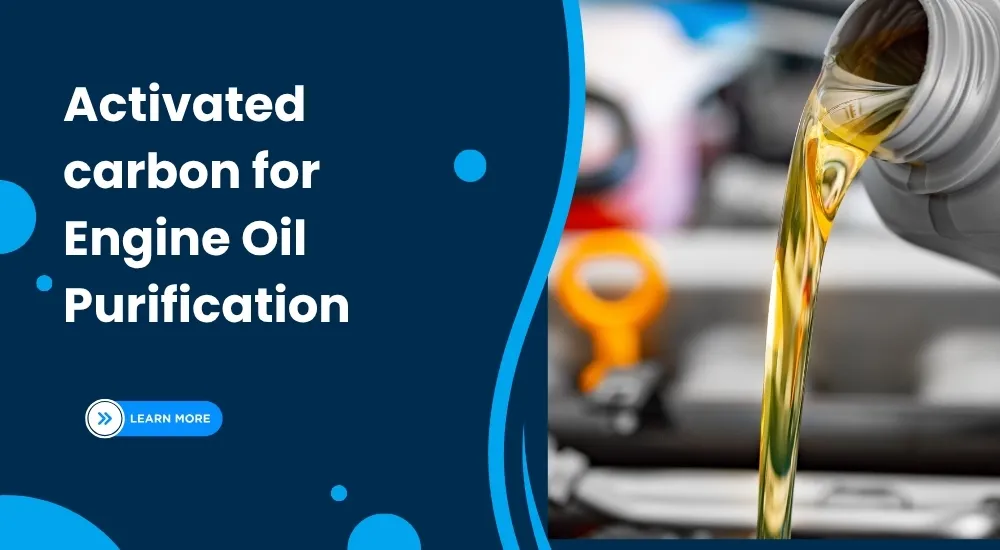
Every liter of used engine oil still contains most of its valuable base stock — the problem is everything the engine put into it. Soot, sludge, oxidized polymers and degraded additives turn the oil black, sour and unsellable. Distillation and acid treatment recover the base oil, but the last shade of dark color usually survives them all. That’s where activated carbon works: as the final polishing step that turns recycled oil into oil a customer will actually pay for.
Why Used Engine Oil Turns Black
Inside a running engine, oil endures temperatures, shear forces and combustion blow-by that steadily break it down. The darkness of used oil is a cocktail of several distinct contaminants:
- Oxidation polymers. Heat and oxygen build resin, varnish and sludge — large, dark molecules that dissolve right back into the oil.
- Soot and carbon residue. Incomplete combustion pushes fine carbon particles into the oil film; some stay suspended no matter how fine the mechanical filter.
- Degraded additives. Detergents and anti-wear packages do their job and then decompose into colored, often acidic, by-products.
- Metals and wear debris. Trace iron, lead, cadmium, chromium and arsenic ride along with the oil and poison its re-refined quality.
Here’s the catch: most of these survive conventional recycling. Settling drops the big solids, dehydration and distillation strip water and light fractions, acid treatment grabs metals — but the polymerized color bodies and polar oxidation products are dissolved in the oil itself. Filtration can’t catch what’s dissolved, and distillation leaves them behind in the residue. The recovered oil comes out dark brown to black, with poor oxidation stability and a burnt smell — and a much lower price tag.
The Whole Purification Process
Think of activated carbon as the final polish, not the whole refinishing process. In a typical waste oil re-refining line, carbon is introduced only after the heavy lifting is done:
• Settling / centrifugation — remove water, sludge and coarse solids.
• Dehydration — heat to ~120 °C to drive off residual water and light volatiles.
• Acid / alkali treatment (where used) — precipitate metals and neutralize acidic compounds.
• Activated carbon adsorption — capture the residual color bodies, oxidized polymers and odor compounds everything else missed.
• Filtration — separate the loaded carbon and deliver the finished base oil.
What the activated carbon actually removes in that step:
• Color bodies. Polycyclic aromatics, asphaltenes and colloidal polymers that give re-refined oil its dark tint. Carbon pulls them out and shifts the oil from near-black to a clear, marketable amber.
• Polar oxidation products. Organic acids and oxygenated compounds formed during service. Removing them measurably improves the oxidation stability of the finished oil.
• Odor compounds. Sulfur species and volatile fractions responsible for the characteristic burnt smell of used oil.
In practice, carbon and bleaching earth are teammates, not rivals. Clay efficiently strips polar impurities and residual acidity; carbon goes after the stubborn dark color bodies and odor. Many refiners blend the two — often 70–80% clay to 20–30% carbon — and get a better result than either media alone.
Activated Carbon Addition Process
Pre-treat properly. Carbon works on liquid, not sludge. Remove water and coarse debris first — dosing carbon into wet oil wastes most of its capacity.
Heat the oil. Bring the pre-treated oil to roughly 80–120 °C. Viscosity drops, so the oil flows into the pores instead of sitting outside them. Too cold and adsorption crawls; there’s no benefit to going hotter than needed.
Dose and stir. Add 1–3% activated carbon by weight (many operations land near 3–4% for heavily darkened oil) with steady agitation for 30–60 minutes. Hold temperature throughout.
Let it finish. After stirring, allow a settling period — several hours to overnight — so the loaded carbon and captured impurities can separate.
Filter clean. Plate-and-frame presses, vacuum filters or centrifuges all work; adding 0.5–1% diatomaceous earth as a filter aid markedly speeds filtration and prevents carbon fines from passing through.
Verify and finalize. Check color and acid value against your target spec. If needed, follow with deodorization (vacuum stripping) and add antioxidant for storage stability.
Bench test before you commit: take a representative sample of your pre-treated oil, run it at three carbon doses, and compare color and yield. Every waste oil batch is different — the dose that worked last month may not be right for this one.
Get Factory Price & Free Samples
Professional activated carbon manufacturer with 21+ years of experience. Customized solutions for water treatment, air purification, food refining, gold recovery and more.
Why Wood-Based Carbon is Suitable
Activated wood carbon develops the mesopore-rich structure that large oil-soluble color bodies need, delivers fast decolorization when dispersed in hot oil, and stays cost-effective at re-refining scale. Coconut-shell carbon, optimized for micropores and gas/vapor adsorption, is generally the wrong tool here; coal-based carbon works but with slower kinetics and weaker decolorizing power per kilogram.
Heycarbon wood powdered activated carbon is produced from natural pine charcoal — sterile, tasteless, non-toxic, and insoluble in oil and common acids/alkalis. Typical specifications:
| Parameter | Wood Powdered Activated Carbon |
|---|---|
| Mesh size (coarseness) | 200 / 325 mesh |
| Caramel decolorization capacity | ≥ 120% |
| Methylene blue adsorption value | 18 mL/0.1 g |
| Ash content | ≤ 3% |
| Moisture | 10–20% |
| Chloride | ≤ 0.1% |
| pH | 3–5 |
Frequently Asked Questions
Can activated carbon alone turn used engine oil back into base oil?
No — it’s a polishing step, not a complete process. Water, fuel dilution, solids and most metals must first be removed by settling, dehydration, distillation or acid/alkali treatment. Carbon then handles the residual color bodies and oxidation products.
How much carbon do I need per ton of used oil?
Typically 1–5% by weight; around 3–4% is common for dark oil. Run a bench test on each batch to set the exact dose.
Should I use it with bleaching earth?
Usually yes. Clay takes polar impurities and residual acids; carbon takes dark color bodies and odor. Blended, they outperform either alone.
The oil is still dark after treatment — why?
Check four things in order: oil temperature (too cool), contact time (too short), dosage (too low for the pigment load), and carbon fines passing the filter.
Conclusion
Positioned after distillation or acid treatment, a wood-based powdered carbon polishing step strips the dark color, oxidation products and odor that every other stage leaves behind — at a fraction of the cost of deeper refining. Turning waste oil back into product? Contact Heycarbons for a free sample of our wood powdered activated carbon and a dosage recommendation based on your oil.