




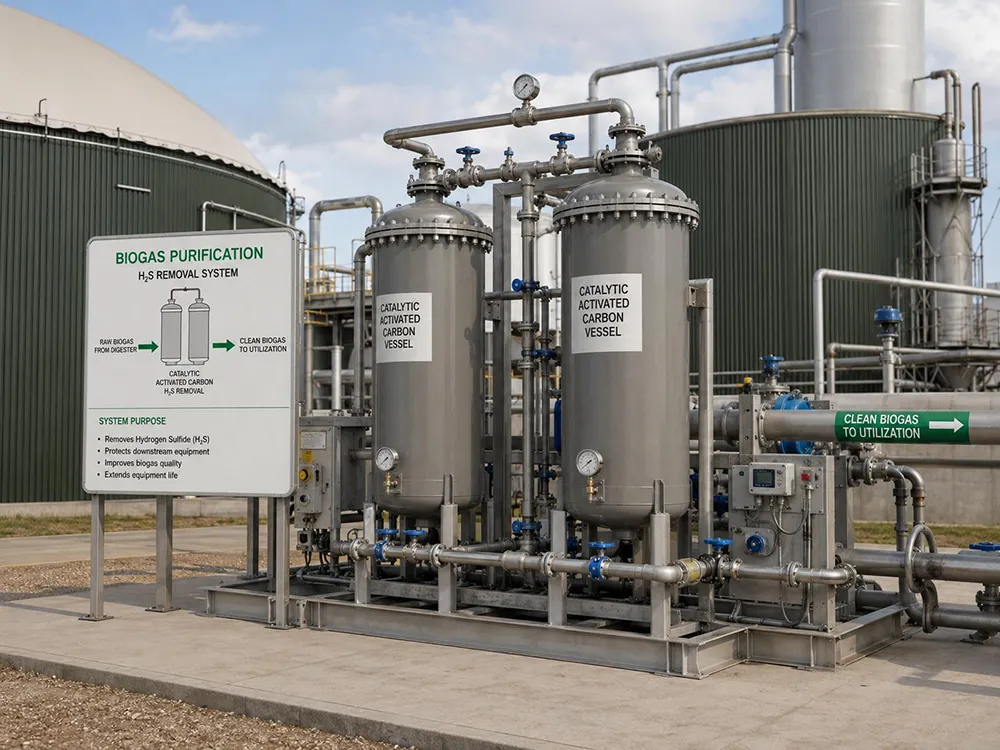
A biogas plant replaced its H₂S polishing carbon every quarter. The new supplier’s datasheet for a copper-oxide impregnated grade promised “no oxygen or humidity required” — an attractive claim for a gas stream that was, by design, nearly oxygen-free. The bed held three months, then broke through. The supplier blamed the gas. The lab blamed the supplier’s chemistry: CuO is not universal for all hydrogen sulfide; it is an oxygen donor. It donates the oxygen that converts H₂S to elemental sulfur, it gets reduced and consumed in the process, and if the gas stream carries no oxygen to replenish it, the chemistry quietly downgrades from catalytic oxidation to one-shot stoichiometric adsorption — and capacity craters.
That datasheet claim is repeated across supplier pages, and it is the most expensive misunderstanding in this product category. Here is how CuO impregnated activated carbon actually works, what to specify, and how to diagnose a bed that is dying early.
Why needs CuO Impregnated Carbon
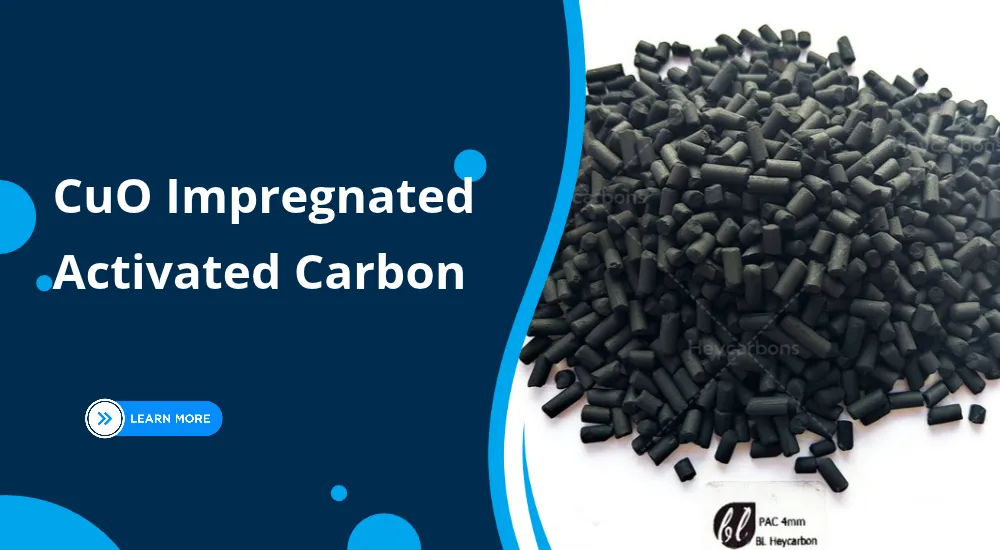
Hydrogen sulfide is the universal poison of gas infrastructure: it corrodes pipelines and compressors, kills reformer catalysts and fuel cells, and smells worse than any other molecule at ppb levels. Standard activated carbon handles low H₂S loads by physical adsorption, but virgin carbon’s H₂S capacity is modest and unpredictable. Impregnation changes the game: grades loaded with CuO (typically 5–15% copper by weight) or with alkali (KOH/KI) convert adsorption into chemistry, multiplying breakthrough capacity and pushing outlet concentrations into the ppb range. CuO grades occupy a specific niche: deep polishing of H₂S and light mercaptans at low concentrations, in natural gas, biogas, and process gases, where outlet targets are below 1 ppmv and often below 0.1.
The Mechanism of CuO
Modern mechanistic studies on Cu-impregnated carbon removing ppm-level H₂S identify three simultaneous reactions:
- Catalytic oxidation: H₂S + ½O₂ → S⁰ + H₂O, with CuO acting as the oxidation catalyst. The product, elemental sulfur, deposits in the pores.
- Reactive adsorption: CuO + H₂S → CuS + H₂O. Copper oxide is consumed stoichiometrically, converting to copper sulfide.
- Sulfate formation: partial over-oxidation to CuSO₄, which consumes oxygen species and slowly deactivates sites.
Regeneration is key. In oxygen-containing gas, CuS re‑oxidizes to CuO with elemental sulfur deposited in pores (CuS + O₂ → CuO + S⁰). This cycle makes the bed catalytic, so 10% CuO loading delivers sulfur capacity much higher than the copper mass itself.
Under anaerobic conditions, conversion stops at CuS. Copper can only react once; capacity is capped by loading, and the impregnation advantage is lost. Only low levels of oxygen (trace oxygen in biogas/odor gas) are required to sustain cycling.
At ~30°C, catalytic oxidation dominates. Near 60°C, reactive adsorption and sulfate formation accelerate kinetics but reduce capacity. The media also removes light mercaptans for odor abatement, mostly via the carbon’s surface oxygen instead of copper.
Selection: Impregnated Carbon Types Compared
| Grade | Impregnant | Best duty | Typical capacity | Key constraint |
| CuO impregnated, 4 mm pellet | CuO 5–15% | Deep H₂S polish, ppm-level inlet, ppb outlet | H₂S breakthrough ≥ 25% w/w (oxygen present) | Needs O₂ in the stream; moderate humidity |
| KI impregnated | KI 2–5% | H₂S + mercaptan odor control | 0.20–0.40 g/g | Oxygen-dependent catalysis |
| KOH impregnated | KOH 5–10% | High-H₂S biogas | 0.15–0.25 g/g | High humidity tolerance; alkaline |
| Sulfur-impregnated | S 10–15% | Mercury (not H₂S) | Hg capacity | Wrong tool for H₂S duty |
| Virgin (unimpregnated) | None | Trace H₂S with air, bulk VOC | Low and variable | Unpredictable below ppm |
CuO grades earn their premium where the target is deep polish on a dilute stream — protecting fuel cells, reformer catalysts, and downstream membranes — rather than bulk desulfurization of rich biogas, where KOH-impregnated carbon is usually the economic choice.
Часто задаваемые вопросы
How does CuO impregnated activated carbon remove H₂S?
Through coupled chemistry: CuO catalyzes the oxidation of H₂S to elemental sulfur (deposited in the pores) while also reacting directly to form CuS. In oxygen-containing gas, CuS is re-oxidized back to CuO, regenerating the active site and sustaining high capacity.
Does CuO carbon really work without oxygen?
No — this is the common marketing overstatement. CuO donates oxygen to the reaction and is consumed; without O₂ in the stream to regenerate CuS back to CuO, capacity is limited by the copper loading and the bed behaves as a single-use stoichiometric adsorbent.
What capacity should I expect from a quality CuO grade?
H₂S breakthrough capacities of 20–25% by weight are achievable with ~10% CuO loading, oxygen present, and moderate humidity. Capacity without oxygen may be several times lower — always ask what test conditions the quoted figure assumes.
Can CuO impregnated carbon be regenerated?
Yes, by oxidative thermal treatment — hot dilute oxygen converts CuS back to CuO and burns off deposited sulfur — but this is a specialist off-site process. Most polishing installations replace the carbon, sizing beds for months of service.
How do I choose between CuO, KI, and KOH impregnated carbon?
Rich biogas with high H₂S: KOH grades. Odor control with mercaptans: KI or blended media. Deep ppm-to-ppb polishing of natural gas or fuel-cell feed: CuO grades, provided the stream carries some oxygen. Match the impregnant to the sulfur load and the oxygen available.
Итог
CuO-impregnated activated carbon is ideal for trace H₂S polishing. Its catalytic cycle relies on oxygen in the gas feed; regeneration stops under fully anaerobic conditions, resulting in a dramatic drop in usable sulfur capacity.
Send over your gas analysis data, and we will help you select the right media grade.