




You’ve probably never seen activated carbon — yet it touches your life every single day. It’s inside the filter pitcher in your fridge, the air purifier humming in the corner, the water treatment plant upstream of your city, and even the emergency room, where doctors reach for it when someone has swallowed something poisonous.
So what exactly is this black, and why activated carbon can be used from making tap water taste better to recovering gold from ore? Let’s explore it.
¿Qué es el carbón activado?
Activated carbon (also called activated charcoal) is a form of carbon that has been specially processed to become extremely porous. Millions of microscopic pores and tunnels are opened up within each particle, creating an enormous internal surface where contaminants can be captured. The word “activated” is the key. Ordinary charcoal already has some ability to grab molecules, but activation is the manufacturing step that multiplies that ability many times over. Without it, you just have charcoal — a fuel, not a purifier.
Surface Area and Pores
Surface area is the foundation of carbon filtration, because adsorption is a surface-driven process. Contaminants are captured only where they physically touch the carbon surface.
Not all pores are the same size, and that’s actually a feature. They’re usually grouped into three categories:
| Pore Type | Width | What It Catches Best |
| Micropores | Under 2 nm | Small gas molecules — odors, VOCs, chlorine |
| Mesopores | 2–50 nm | Mid-sized organic compounds, color bodies |
| Macropores | Over 50 nm | Entry channels leading into the inner network |
The mix of pore sizes depends heavily on the raw material and activation method — which is why different carbons are suited to different jobs. A carbon optimized for catching small gas molecules isn’t necessarily the best choice for decolorizing sugar syrup.
How Activated Carbon Is Made
The manufacturing process is essentially a two-stage transformation of ordinary organic matter into a molecular sponge.
Step 1: Carbonization
A carbon-rich raw material — coconut shells, bituminous coal, wood, or bamboo — is heated to roughly 600–900 °C in an environment with little or no oxygen. This drives off water, tars, and volatile compounds, leaving behind a lightweight carbon skeleton called char. Without oxygen, the material burns away rather than burning up.
Step 2: Activation
The char is then exposed to steam or carbon dioxide at 800–1,100 °C (physical activation), or treated with chemicals such as phosphoric acid at lower temperatures (chemical activation). Either way, the result is the same: newly etched pores open up throughout the carbon, creating the vast internal surface that gives the material its power.
Finishing
The activated carbon is washed, dried, crushed, and screened into its final form — granules, powder, or pressed pellets — and tested for properties like adsorption capacity and hardness before shipping.
A bonus of this process: when activated carbon is eventually “full,” it can often be reactivated at high temperature in a kiln, burning off the captured contaminants and restoring most of its capacity. This makes it both cost-effective and relatively sustainable for large industrial users.
Consigue precios de fábrica y muestras gratuitas
Fabricante especializado en carbón activado con más de 21 años de experiencia. Soluciones a medida para el tratamiento del agua, la purificación del aire, el refinado de alimentos, la recuperación de oro y mucho más.
The Main Types of Activated Carbon
Activated carbon isn’t one product — it’s a family of them, shaped for different tasks.
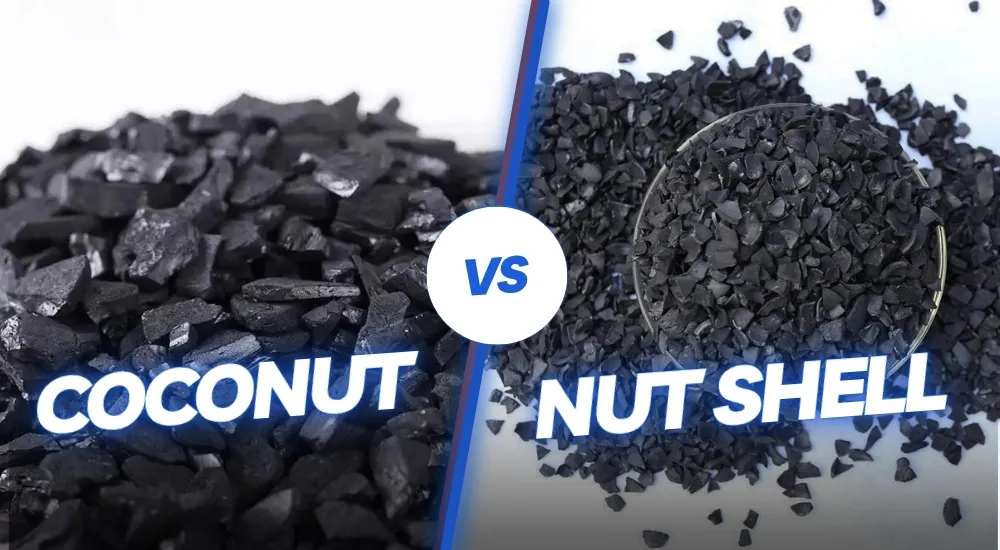
Carbón activado granular (GAC) — Irregular particles a few millimeters across. Water flows through beds of GAC with low resistance, making it the workhorse of municipal water treatment, whole-house filters, and aquarium systems.
Powdered Activated Carbon (PAC) — Ground into a fine powder, it offers extremely fast adsorption because contaminants have a short distance to travel to a pore. It’s dosed directly into water or used for decolorizing in food and pharmaceutical production, then filtered out after doing its job.
Pelletized / Extruded Activated Carbon — Cylindrical pellets pressed into uniform shapes. They combine low dust, high mechanical strength, and predictable flow paths, which suits gas-phase work: VOC control, solvent recovery, and industrial air scrubbing.
Honeycomb Carbon Block — Powdered carbon compressed with a binder into a solid block. The dense structure forces water through tortuous pathways, achieving very fine filtration in compact cartridges.
Impregnated Carbons — Standard carbon treated with specialty chemicals to target specific gases like hydrogen sulfide or mercury vapor, which plain carbon struggles to hold.
Activated Carbon Application
The applications span from your kitchen to gold mines:
- Drinking water treatment — removing chlorine, taste and odor compounds, pesticides, and disinfection byproducts at both municipal plants and under-sink filters
- Air purification — the only common residential filter media that captures gases and odors; HEPA filters trap particles, but gas molecules are thousands of times smaller and sail right through them
- Alimentación y bebidas — decolorizing sugar syrup, purifying vodka, clarifying juice, and decaffeinating coffee
- Medicine — hospital emergency rooms administer activated charcoal orally to adsorb certain poisons before they enter the bloodstream
- Gold recovery — mining operations rely on carbon’s selective adsorption to pull dissolved gold out of ore solutions
- Environmental cleanup — treating contaminated groundwater and industrial wastewater before it reaches rivers
- Everyday comfort — refrigerator deodorizers, car cabin filters, face masks, and shoe insoles
How to Choose a Good Activated Carbon
If you’re sourcing activated carbon — or just evaluating a filter product — these are the specifications that actually matter:
- Índice de yodo — the standard proxy for adsorption capacity. Higher generally means more micropores and better performance against small molecules. Quality grades typically range from 500 to over 1,100 mg/g.
- Surface area — usually 500–1,500 m²/g for standard grades; premium products can approach 3,000 m²/g.
- Pore size distribution — match it to your target contaminant. Micropores for gases, broader pores for larger organics.
- Hardness / attrition — soft carbon crumbles into dust, clogging beds and losing product. Critical for pellet and granular grades.
- Ash and moisture content — excess ash can leach impurities; excess moisture means you’re paying for water, not carbon.
Preguntas frecuentes
Is activated carbon the same as activated charcoal? Yes. The two names describe the same material. “Activated charcoal” is more common in consumer and medical contexts; “activated carbon” dominates industrial and scientific usage.
Does activated carbon expire if unopened? Stored dry in a sealed package away from odors, activated carbon keeps its capacity for years. It only “loads up” when actually exposed to contaminants.
Can I reactivate carbon at home? Not realistically. Industrial reactivation requires kilns running at 800 °C+ under controlled conditions. For home filters, replacement is the correct and safe approach.
How long does an activated carbon filter last?
It depends on contaminant load and usage. A drinking water pitcher cartridge might last 1–3 months; a whole-house system, 6–12 months; an air purifier carbon bed in a lightly polluted room, a year or more. When odors start returning or taste changes, the carbon is saturated.
Is activated carbon safe? Yes — it’s inert, non-toxic, and used in food, beverages, and medicine. (Note: medical activated charcoal should only be used under professional guidance, and it is not the same as barbecue charcoal.)
Conclusión
To sum up, activated carbon’s purification capability stems from its vast, tunable internal pore structure created during carbonization and activation. It operates via adsorption to capture organic molecules, odors and chlorine‑related compounds from air and water, yet it cannot remove all contaminants. Different feedstocks and product forms — GAC, PAC, pellet and impregnated carbon — serve distinct real‑world scenarios.
Looking for the right activated carbon for water, air, or industrial applications? Explore our product range or contact us for a recommendation tailored to your specific purification challenge.