





Gold recovery
Carbon in Column Gold Recovery
Carbon-in-column (CIC) is a gold recovery process designed for clarified pregnant gold solution, separating it from slurry-based CIP/CIL routes. The packed carbon bed needs to retain its structure under continuous solution flow, limit fine carbon generation that causes gold loss, and support high gold uptake for profitable stripping runs. Consistent carbon sizing prevents channeling and ensures even solution contact across the whole bed.
Especificaciones típicas
Ranges, not single numbers, because the grade follows the duty. Every value carries the method it is measured by, so you can line our COA up against any other supplier's.
| Property | Valor típico | Método de ensayo |
|---|---|---|
| Base material | Coconut shell, granular, de-dusted | Visual and lot records |
| Mesh size | 2mm, 4mm or Customized | ASTM D2862 |
| Índice de yodo | ≥ 1,050 mg/g (950–1,200 across the range) | ASTM D4607 |
| CTC activity | ≥ 55% (50–70% across the range) | ASTM D3467 |
| Ball-pan hardness | ≥ 98% | ASTM D3802 |
| Abrasion number | ≥ 80 | ASTM D3802 |
| Contenido en cenizas | ≤ 3% | ASTM D2866 |
| Moisture as packed | ≤ 5% | ASTM D2867 |
| Densidad aparente | 0.45–0.55 g/cm³ | ASTM D2854 |
| Superficie específica (BET) | 1,000–1,200 m²/g | ISO 9277 |
| pH of aqueous extract | 8–11 | ASTM D3838 |
Carbon in column application
Heap leach pregnant solution
Solution from the pad, clarified before it reaches the columns. The classic CIC duty, where mesh and screen retention decide carbon loss.
Tailings dam return water
Gold that left in the tails reports to the dam, and the return water carries some back. A column between dam and plant recovers it.
Mine runoff and seepage
Rain and seepage across the site collect in a pond. Collecting the soluble gold from it with a carbon column is standard practice.
Overflow and decant solution
Clarifier overflow, thickener decant and other clear streams that would otherwise be treated as waste.
Barren solution polishing
A guard bed on the barren solution catches what the main adsorption stage missed, before it returns to the pad.
Small fixed-bed plants
Operations without slurry agitation can run a simple packed column train instead of a full CIL or CIP circuit.
Fabricante de carbón activado de alta calidad desde 2005
Fabricante de carbón activado que da prioridad a la calidad; un riguroso control de calidad garantiza unas especificaciones estables y plazos de entrega rápidos para los compradores de todo el mundo.
Más de 21 años de experiencia
Fabricación de carbón activado desde 2005.
Capacidad anual de 20 000 toneladas
Producción a gran escala, plazos de entrega estables.
Presente en más de 80 países
Europa, América, Asia, África.
Certificado según la norma ISO 9001
Sistema integral de gestión de la calidad.
Laboratorio de control de calidad in situ
Cada lote se somete a pruebas antes de su envío.
OEM / ODM disponibles
Tamaño de malla personalizado, embalaje y marca.


Preguntas que nos hacen los compradores
What is the difference between CIC and CIP/CIL?+
Carbon in column treats clear solution through stationary or suspended carbon. In CIP and CIL the carbon circulates inside the leach slurry and is pumped, agitated, screened and abraded for its whole life. A column is kinder to the particle, but it has no tolerance for solids that would plug a packed bed. See the wider gold recovery process for where each stage sits.
Packed bed or fluid bed — which do I need?+
Start with the suspended solids in your feed. Clear solution suits a packed bed: less carbon for the same throughput and higher recovery per pass. Any slime at all points to a fluid bed, which tolerates solids and lets you draw loaded carbon off the bottom without stopping the column. A packed bed above about 5 gpm/ft² starts to move; a fluid bed below its fluidisation velocity settles and plugs.
Which mesh size for a CIC column?+
6×12 mesh is the default for packed beds and the size most circuits are screened for. 4×8 trades some kinetics for a lower pressure drop, which suits large columns and dilute circuits. 8×16 gives faster uptake where contact time is tight, but needs finer screens. Fluid beds run −6+16 or −12+30 so the particles stay suspended. Match the mesh to the interstage screen opening first; our 6×12 mesh gold recovery carbon page carries the graded specification.
How much gold will the carbon hold before it is stripped?+
Practice is to strip 100–400 oz of precious metals per tonne of carbon. On a dilute solution — under about 0.05 oz Au per tonne, around 1.7 g/t — loading usually tops out near 200 oz/t, because the carbon is working against a very low concentration. Copper, nickel and silver take sites before gold in some liquors, and organics block pores. Ask for a loading test on your own liquor.
How is the gold stripped, and can the carbon be reused?+
The standard strip is hot caustic cyanide, around 1.0% NaOH with 0.1% NaCN, run boiling or under pressure at 40–150 °C; hot caustic alone has also worked at some operations. The carbon is then washed with dilute acid at pH 1–2 to dissolve carbonate and metal-cyanide deposits, reactivated and returned to the circuit. Damage in service is mostly mechanical, so hardness decides how many cycles a carbon survives.
Can coal based or extruded carbon be used in a CIC column?+
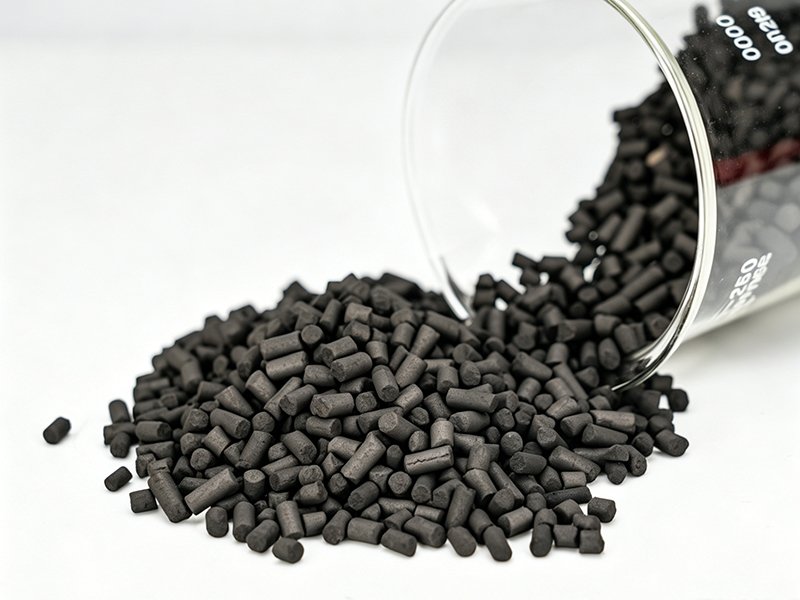
Coconut shell granular carbon is the default: hardness and low ash are what a repeatedly stripped column needs, and its micropore structure fits the gold-cyanide complex. Extruded carbon — coconut shell pellets or coal based pellets — gives a lower pressure drop and a very uniform bed, which suits tall columns and fast flow. Coal based grades run higher ash, so check ash and hardness against your own specification and test a small column first.
Get Good Quality Carbon in Column Gold Recovery
Nos especializamos en suministrar carbón activado de alta calidad a clientes de todo el mundo. Ponte en contacto con nosotros hoy mismo para solicitar una muestra gratuita y un presupuesto personalizado.